
The Master of Disguise
François Eugène Vidocq
May 22, 2016
While Jonathan Wild laid the corrupt foundation of private detection, it was François Eugène Vidocq who transformed the trade into a sophisticated science. In his youth, Vidocq was a study in contradictions: a gifted student who preferred the adrenaline of the duel and the art of the sword. His most formidable talent, however, was his chameleonic ability to inhabit other identities—a skill that served him well when he enlisted during the French Revolution and rose to the rank of Senior Lieutenant.
Yet, Vidocq was a spirit easily bored by the rigidity of military life. He utilized his mastery of disguise to desert his post, initiating a legendary cycle of capture and escape. These exploits didn’t just frustrate authorities; they forged his reputation as a kingpin of the Parisian underworld.
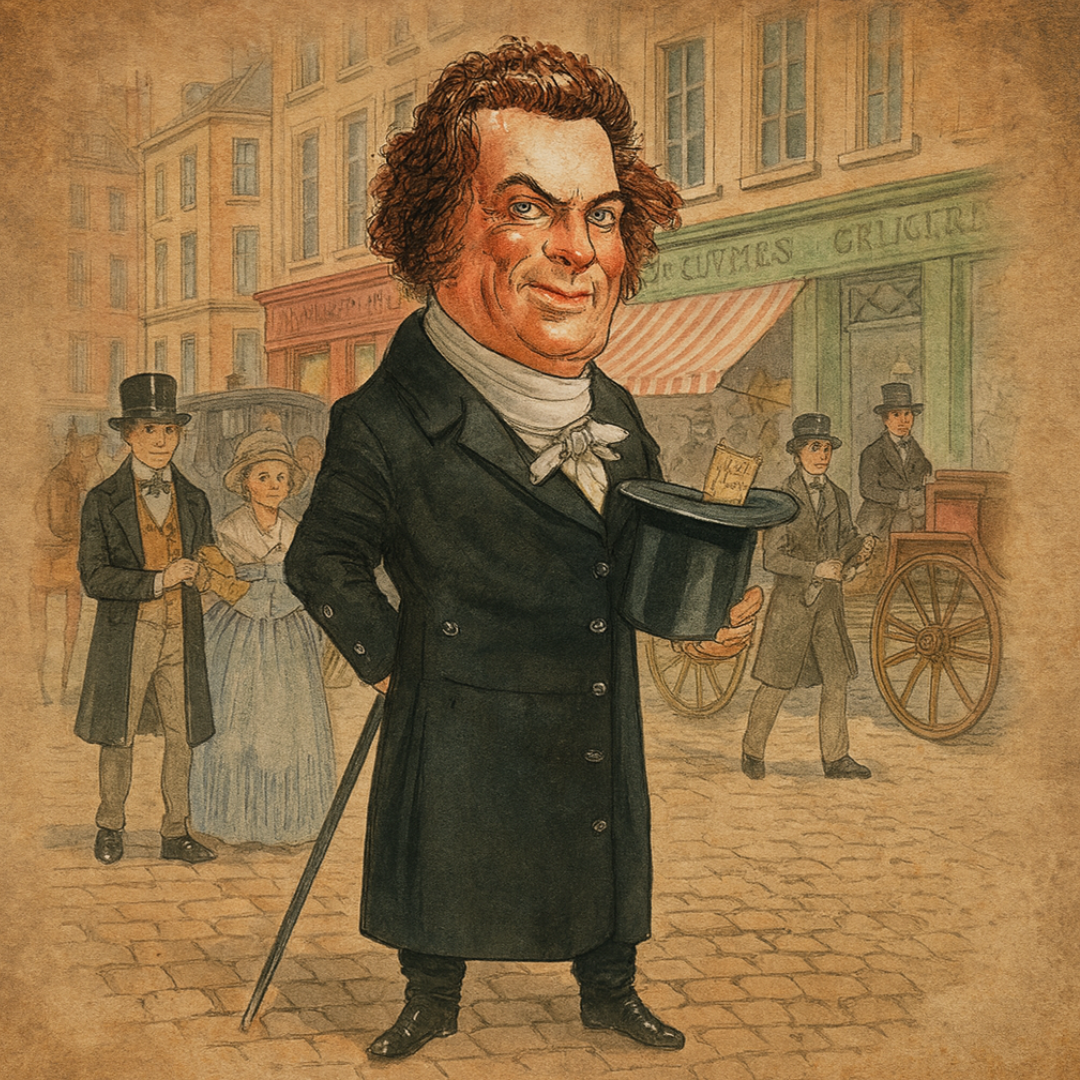
“Vidocq revolutionized law enforcement, introducing the concepts of undercover work, ballistics, and meticulous record-keeping.”
By 1809, with crime rates in France spiraling beyond the control of the uniformed police, Vidocq recognized an opportunity for a strategic pivot. He brokered a daring pact with the Parisian police: he would leverage his intimate knowledge of the criminal class to serve as a confidential informant. In exchange, the police would grant him an amnesty for his own past transgressions. This arrangement made Vidocq the world’s first professional confidential informant. He didn’t merely “rat” on his peers; he infiltrated gangs as a police spy, eventually aiding in the capture of over 800 criminals—a staggering figure for the early 19th century.
His success was so undeniable that, by 1811, Vidocq was appointed the first chief of the Sûreté, the French criminal investigation department. In 1812, he formally organized the Brigade de la Sûreté, the world’s first dedicated detective bureau, which he staffed almost exclusively with former convicts. This “poacher-turned-gamekeeper” model revolutionized law enforcement by introducing concepts such as undercover work, ballistics, and meticulous record-keeping.
Following his final resignation in 1833, Vidocq pivoted toward the private sector. In 1834, he established Le Bureau des Renseignements Universels pour le Commerce et l’Industrie, the first private detective agency in the world. Building upon Wild’s fee-for-service model, Vidocq expanded the scope of private work to include commercial intelligence. He is credited with founding the first Trade Protection Society, a precursor to modern consumer reporting agencies, which allowed merchants to verify the creditworthiness of potential clients.
The ripple effects of Vidocq’s innovations were global. His successes provided the blueprint for Scotland Yard’s Criminal Investigation Department (CID) in 1842, and served as the direct inspiration for Allan Pinkerton, who established his own legendary agency in 1850.