
Baby Reindeer (2024)
When "True Story" Becomes Slander: The Ethical Collapse of Autofiction
I didn’t watch Baby Reindeer when it first premiered, as from the initial trailers and promotional buzz, it was immediately evident that the series centered on creator and lead actor Richard Gadd’s lived trauma of being relentlessly stalked by a woman. At that time, I was unwilling to expend the emotional energy required to dive into someone else’s raw pain and psychological turmoil.
Even though I did my best to avoid spoilers, the cultural chatter around the show was unavoidable. It won Golden Globes, BAFTA, Emmys, and Peabody Awards. Soon after, word circulated that Gadd’s real-life stalker was preparing legal action against Netflix. I gave it time, waiting for the legal dust to settle, before finally sitting down to watch it.
The Narrative Arc: Marketed as a raw, dark psychological thriller, Baby Reindeer traces the unraveling life of Donny Dunn—a struggling stand-up comedian working behind the bar at a London pub. Out of simple pity, Donny offers Martha, a visibly distressed customer at his counter, a free cup of tea. That brief gesture ignites a suffocating, unrelenting obsession in Martha, who inundates Donny’s digital inbox with thousands of messages, tracks his movements, and violently insinuates herself into his personal life, targeting both his trans partner and his family.
Over time, Martha’s psychological grip tightens to the extent that she sexually assaults Donny. Yet, Donny hesitates to take decisive legal action and repeatedly sends mixed signals, struggling to sever ties permanently. Martha devolves from a pitiable woman who probably mistook Donny’s kindness for an invitation to romance into a relentless predator. The show concludes with Martha behind bars and Donny receiving the same kind gesture he once showed Martha from an unfamiliar bartender.
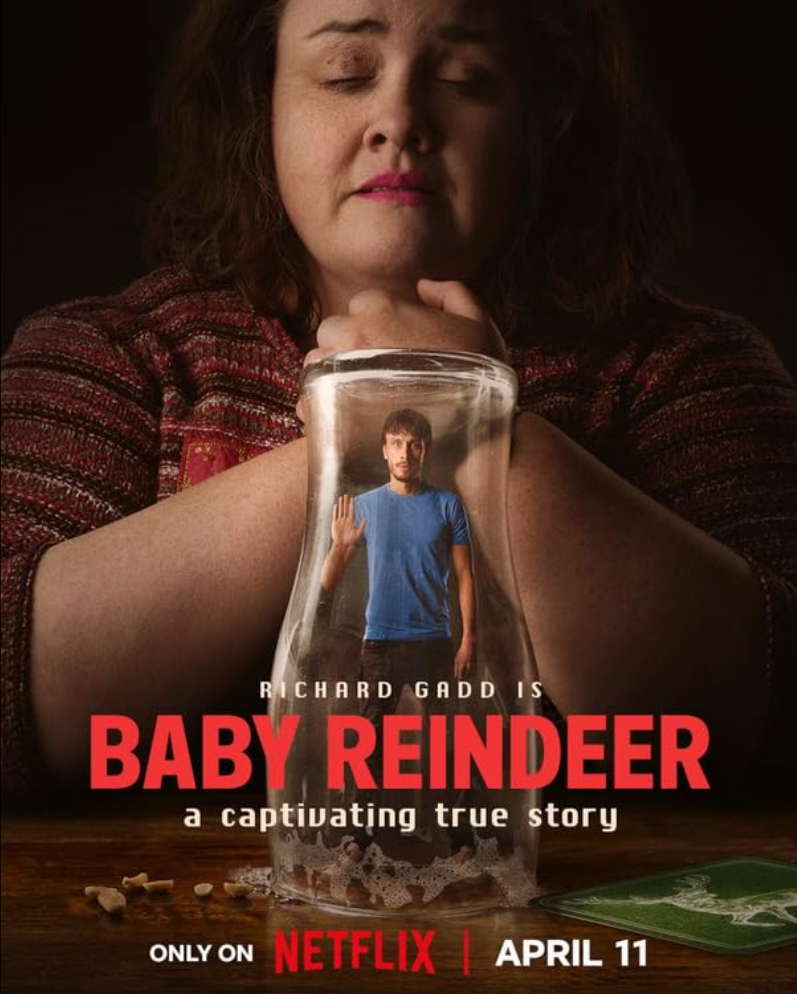
What I appreciate most about Baby Reindeer is its emotional rawness. Instead of relying on hackneyed melodrama—characters screaming, punching walls, or wallowing beneath a manipulative score—Baby Reindeer portrays how Martha’s obsessive behavior corrodes Donny’s everyday life, his friends, his family, and his love interest. Through this ordeal, Donny is forced to confront the brutal reality that he was previously groomed and sexually assaulted by an influential television writer.
It is the pivotal realization for Donny—and for the audience—as to why he keeps tolerating Martha’s obsession, why he doesn’t report her, or actively protect himself. Donny’s unresolved trauma fuels a self-destructive dynamic, making him paradoxically crave the toxic validation Martha provides.
I can relate to that part of Donny.
When your self-worth is so low that you believe you deserve all the misery inflicted on you, the abuse and toxicity become your baseline equilibrium—it is all you know.
Another thing I appreciate is Donny’s unvarnished fallibility. Usually in autofiction, the protagonist is heavily sanitized. Storytellers might grant their stand-in a minor flaw, but mostly the protagonist remains an idealized victim. In Baby Reindeer, Gadd shows Donny warts and all. It is reminiscent of author David Sedaris’ essays, where Sedaris lays bare his most cringeworthy moments.
I kept binge-watching the seven episodes because of the subject matter: an adult male being stalked by an adult woman. Even though movies like Fatal Attraction, Play Misty for Me, or Obsessed share the same theme, they are superficial thrillers lacking authentic psychological depth. Only Stephen King’s Misery comes close to the ick factor. But Misery is primarily about the stalker herself and her unchecked psychopathy. I feel as though the reality that men can also be victimized was last culturally discussed during an Oprah Winfrey Show episode where male victims of sexual assault gathered together publicly for the first time.
Baby Reindeer elevates that discourse. Even though the protagonist is deeply flawed, he commands the audience's empathy. While on the surface he struggles to break free from his stalker, internally he wrestles with self-forgiveness for the abuse endured at the hands of the TV writer.
Everything is so real, emotional, and raw that I am held captive, like a voyeur.
It chills my bones, yet I can’t detach myself from Donny’s pain.
Even though Baby Reindeer is adapted from Gadd’s stage play, and hence the audience experiences the events strictly from Gadd’s perspective, I crave a bit more insight into Martha. Who is Martha? Does she have, or has she had, any friends or family? How does she earn a living? Most importantly, does she have any good in her?
Is Martha like Jackie in Nurse Jackie? Whether Jackie is good or bad is complicated. She is deeply empathetic toward her patients, driven partly by a twisted need to be seen as the ultimate savior, yet she saves countless lives in the process. She uses her friends, but she genuinely feels guilty. But Martha, on the other hand, comes across as a flat, irredeemable monster.
After the credits rolled, I felt compelled to learn everything about the real Martha—mostly to find a single redeeming quality in her.
Since Martha’s character is based on a flesh-and-blood human, I reasoned she couldn’t possibly be as cold-blooded as Anton Chigurh in No Country for Old Men.
In my internet sleuthing, I expected mundane updates like where they are now, or blurry snapshots of the real Martha. Of course I didn’t expect the real Martha to have horns or a neon warning sign plastered across her forehead. Instead, I discovered an avalanche that has left me questioning Gadd’s veracity and Netflix’s ethics.
Way before me, the internet detectives had already unearthed the real identity of Martha, matching a highly specific dialogue detail, “hanging curtains,” to a real tweet sent to Gadd from Fiona Harvey. Meanwhile, the identity of the abusive television writer remains unconfirmed despite a lot of reckless witch-hunts.
Harvey is a Scottish woman with a law degree living in London. In 2024, Piers Morgan interviewed her, and she acknowledged knowing Gadd and inspiring minor details, such as the nickname “Baby Reindeer.” But she vehemently denied being a stalker and referred to the series as “obscene” and “horrifying,” while denying that she ever sent Gadd thousands of emails, attacked his girlfriend, or sexually and physically assaulted him.
Following the interview, Harvey filed a $170 million defamation lawsuit against Netflix. Her core argument is that Netflix slapped a definitive statement, “This is a true story,” onto the opening of each episode. Netflix never fact-checked and falsely led viewers to believe that Martha—i.e., Harvey—is a twice-convicted stalker who had served years in prison and committed aggravated sexual assault.
The actual court filings reveal that virtually every climactic element portrayed on screen was manufactured: that Martha was a convicted felon known to authorities, that she harassed a police officer, that she physically and sexually assaulted Donny, that she bombarded his parents with threatening calls, assaulted his girlfriend in the street by tearing out her hair, or stalked his flat by manipulating his landlady.
A California federal judge ruled against Netflix's motion to dismiss, stating point-blank that the show was not a true story. The judge specifically noted that there is a "major difference between stalking and being convicted of stalking in a court of law," as well as "between inappropriate touching and sexual assault, as well as between shoving and gouging another's eyes."
Harvey is not a pristine person. In a civil dispute, long before meeting Gadd, Harvey had an interim non-harassment order against her from a Scottish lawyer, which the series falsely inflated into a four-year prison sentence.
These plot points are not merely heightened for dramatic effect or embellished around the margins—they are wholesale fabrications, without an iota of truth, sold to viewers as a “true story.”
Gadd’s defense is that the events are “emotionally true,” insisting that such drastic fictionalization should be forgiven as artistic liberty.
It is like saying that a jug containing 90% tap water should be happily downed because the label screams “100% Whole Milk.”
Hence, I suspect Gadd’s veracity. Long before Baby Reindeer, Gadd performed Monkey See, Monkey Do about his assault by the TV writer. Now it raises the question: if Gadd amplified the stalker story by inventing physical assaults, police corruption, and jail time, how much dramatic license did he take with his other autobiographical stories? If Netflix were to make that into a series, will people come out of the woodwork to discredit Gadd’s version?
This recurring habit of inflating reality makes me realize how fragile narrative truth is when basic diligence is discarded. When I was doing my research project on the first woman detective in India, I had to refer to sources and cross-check and fact-check everything multiple times lest I state something false about a real person’s life. If an independent researcher is expected to maintain that standard of ethical rigor, did Netflix really not fact-check, or maybe the producers of Baby Reindeer were trying to be clever like Fargo?
Who knows. Nevertheless, Baby Reindeer has joined the list of When They See Us, Winning Time, and the film adaptation of The Blind Side as prestige media masquerading as objective reality while running wild with the facts.
What if the producers had truthfully used "dramatization based on a true story," like The Staircase? Despite being a dramatization, The Staircase honors the ambiguity of a real tragedy without inventing convictions or fabricating crimes to keep the viewer hooked.
Had I known Baby Reindeer was a dramatization, I would still have engaged with Donny and Martha fully through the lens of psychological fiction, admiring its bleak, suffocating tension much like Stephen King’s Misery. But I would not have been consumed by frantic queries into how such an unchecked predator escaped judicial custody, or how systemic incompetence allowed such terror to fester unpunished.
Netflix understood that stamping “This is a true story” across the opening frames would provoke an immediate, uncritical intimacy from the audience.
It was an intentional trade: exploiting documentary credibility to heighten dramatic stakes.
That choice was entirely unnecessary. On craft alone, the series is exceptional—bolstered by Martha's performance, which swings between pathetic fragility and feral menace, Gadd’s agonizing vulnerability, and an oppressive, claustrophobic visual cadence.
It never needed manufactured falsehoods to feel visceral. I just despise being blatantly lied to.
📸Author Feed ✍️Writing Room 🫂Connections