
Street Art is the Evolving Soul of a City
In Downtown San José, the C-shaped glass-and-steel Zoom Video Communications tower stands alongside the historic Spanish Revival Hotel De Anza, notable for its Spanish accents and prominent Art Deco mural. I find this blend of street art within an urban landscape captivating, as I often see stories in everything, even the everyday.
Although I have lived and worked in different cities across India, I seldom came across modern street art. Most exterior walls were covered with layers of election campaign posters, detracting from the surroundings. Despite this, the urban landscape featured a mix of modern and historic sites from the Mughal and British colonial periods. Multi-story concrete buildings coexisted alongside grand colonnades and intricate latticed screens, seamlessly blending new and old.
My college friends and I often explored Panhala Fort, a medieval stone structure from the Maratha dynasties in Kolhapur. During my first job, I had a desk with an unobstructed view of Mumbai’s Gateway of India, a colonial triumphal arch that resembles a Parisian monument. Years later, my husband and I attended our first Sufi concert at Humayun’s Tomb, immersing ourselves in the living history of the Mughal era in New Delhi. These personal experiences gave me a much richer and more authentic understanding of history than any high school textbook could provide.
In my naivete, I assumed the whole world would reflect my birthplace—a smooth, living mix of the new, the old, and the ancient.
After relocating to the US for graduate studies, I adapted to independent living surprisingly quickly, despite my upbringing in India’s closely-knit, community-oriented culture. Interestingly, the most challenging aspect was coming to terms with the lack of historic monuments in my daily surroundings.
Texas A&M University in College Station had a suburban college-town atmosphere characterized by heavy concrete and the clean, stark lines of Brutalist and Modernist architecture. Everything appeared pristine and almost sterile. At the Langford Architecture Center, where I attended classes, I felt as if I were inside a John le Carré Cold War spy novel. The environment was predominantly gray, monolithic, and unyielding. Frequently, when I stayed late into the night, I wrapped myself in all the woolen clothing I owned. Over my three years there, I often slept in those highly air-conditioned studios, bundled up in my sleeping bag. The only relief in that carpeted, brightly lit maze was the occasional student project displayed on the walls.

I yearned for vibrancy, color, and a touch of messiness. I wondered if all of America was just monochrome, modern, and utilitarian, lacking in color.
After graduating, I moved to a typical Silicon Valley suburb in the Bay Area of California. It had the same clean, well-planned feel as College Station, but was greener, more ethnically diverse, and had its own historic district.
The Mission San José church and its nearby neighborhood near Ohlone College showcase Spanish Mission architecture, featuring thick, whitewashed adobe walls, red clay tile roofs, exposed wooden beams, and arched entrances. Despite these historic features, the landscape maintained a crisp, entirely Americana feel.
Moving to San José was my first real sense of belonging. I felt as if I had finally discovered the eclecticism my soul had been longing for.
Downtown has become my home.
San José has developed over the years, integrating various architectural styles. The Sainte Claire Hotel features Spanish Renaissance Revival architecture, characterized by its brick and terra-cotta façade painted to resemble Mediterranean stone, deep arched windows, and an impressive interior loggia. The Knox-Goodrich Building exemplifies Romanesque Revival, distinguished by its dark, textured, and rugged stone exterior.
Just steps away, the Hensley Historic District boasts the highest density of Victorian-era homes. The Hotel De Anza showcases Zig-Zag Moderne with Spanish influences, while the Modern Drug Company exemplifies Streamline Moderne architecture. Atop Adobe Tower, the orange Semaphore projects cryptic light-art signals. The newest feature is the luminous, cylindrical glass rotunda of San José City Hall. Highlighting the city’s architectural progress is the San José Museum of Art, with its historic Romanesque Revival wing contrasted by the neighboring Postmodern wing featuring geometric cutouts and soaring plaster planes.
Vibrant murals and art installations are spread throughout the city, adding a final touch to the city’s eclectic style.
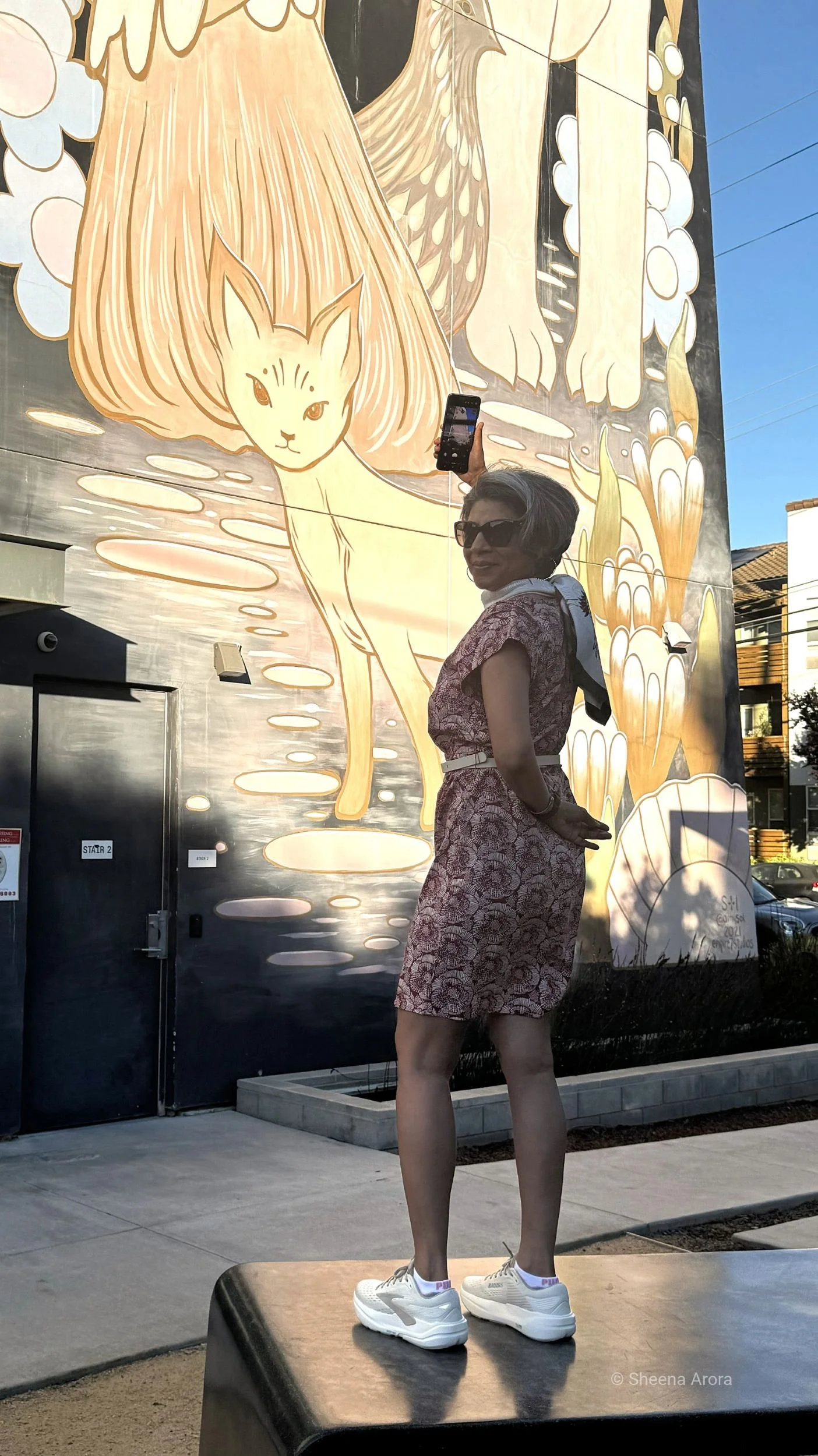
I climbed a picnic table to capture the tall mural.
Over the years, I started exploring my neighborhood on foot, often following my instincts. By chance, I discovered the Opski Chan Mural along the long wall of IBM’s first West Coast manufacturing plant. I’ve walked certain paths so many times that I can tell when paint chips or when a new tag covers old artwork. I don’t depend on street signs; instead, I identify each neighborhood by its unique installations.
On a cool afternoon walk, I reached a familiar four-way intersection near Backesto Park. There was an Indian restaurant now under new management, rental bikes lined up along the curb, and a commercial laundry. However, the San José Sharks mural on the laundry’s exterior was gone, as if it had been erased by a genie. I double-checked my surroundings, worried my memory was failing me. My GPS confirmed I was exactly at the right spot. It was unsettling, as it was the first time I saw street art vanish without a trace. In India, nothing disappeared. You could potentially still find decades-old campaign posters beneath layers of new ones.
I doubted whether the Sharks mural had ever existed. I asked my husband, who vaguely remembered it but wasn’t certain. For a long time, I wondered if my recollection was correct.
Months or possibly a year later, I was at Backesto Park. Children played, families picnicked, and some people shot hoops. An artist was working quietly on the concrete wall of the handball courts, surrounded by ladders, spray cans, and music coming from his pickup. I had never seen a mural being painted live before, but of course, I watched.
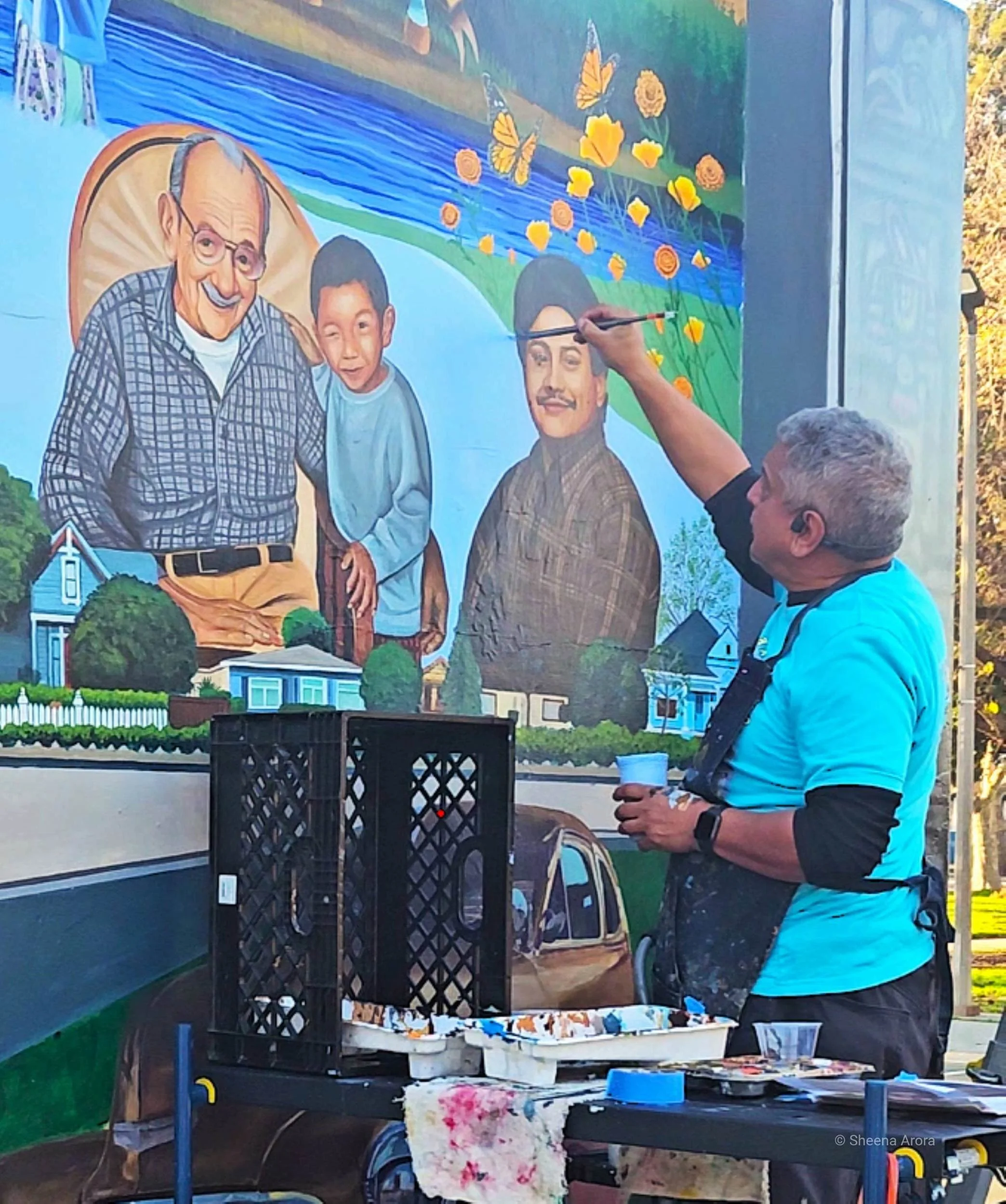
Alfonso Salazar painting "Brown is Beautiful."
Alfonso Salazar was painting a mural that celebrated Chicano and Mexican culture. This grassroots project was privately funded and driven by community members. It involved careful, step-by-step planning, with a few residents posing for the artwork. The artists worked individually on their sections until the entire mural was finished. The process revealed just how much effort goes into street art.
Salazar related examples of other street art that had been painted over to solve my mystery of the missing Sharks mural. He emphasized that urban art is fragile and susceptible to change. It may be commissioned by the city, started by a neighborhood, or donated to a business. However, just one policy change or shift in ownership can erase many years of history in a single day.
That was my epiphanic moment: I realized that, unlike the Mughal palaces of my youth that endure for centuries, street art is tragically temporary.
At the busy intersection of Hedding and 13th Streets, where I cross every day, there’s a student poem carved into a trash can. I’ve always wanted to read it, but I hesitated because I’d have to bend down to see it. It’s not that I cared what others thought of me—since I usually don’t care about others’ opinions—it was just that I didn’t want to be the only one taking a photo of a trash can. Now, I worry that the next time I cross that corner, the poem might be painted over with black paint.
Hence, I chose to pursue my curiosity by capturing as much art as possible. I want to clarify that I’m not creating a documentary or a detailed street art map. My primary goal is to explore the history and stories behind the art around me. I aim to understand the artists’ intentions and to enjoy the learning process. Ultimately, my main motivation is simply to satisfy my curiosity.
📸Life Glimpses 🫂Connections